Wake up early. Glance to the window. Ah, light before 7:00 now. Take a peak outside – today, glowering sky, steady light drizzle. Tomorrow, touch of frost on the grass, sun trying hard. Light 30 seconds earlier the next day. Following day, the afternoon warms up, shed a layer – thankful for 47 degrees when doing physical work. Pacific Chorus Frogs outside are as loud inside as someone speaking – they have mating to do and eggs to lay. It must be February.

In Braiding Sweetgrass, Robin Wall Kimmerer discusses “becoming indigenous to place”. It’s a process by which, through careful observation of the ways other life forms interact with each other and their environment, one develops not only a sense of belonging to their locale, but the drive to care for the relationships that surround them so that future generations can thrive. If we feel like we don’t truly “belong” where we live, we’re less apt to treat our surroundings with respect and care. By eschewing a “settler” mindset, we look at the land (be it small city lot or rural acreage) where we live as something worth protecting. This thought process becomes the basis of our commitment to participate in local restoration endeavors, to cultivate plants that benefit insects, to grow healthy food for our families, to pick shattered plastic bits from the soil when we dig.
I spent a lot of my life feeling quite a bit of loathing for this time of year. Late winter always felt like a drudge, waiting for the warmth of the growing season, endless dampness taking its toll. It was a rush to get to the luxuriance of spring, leave these bare stems behind. These days, I’ve developed a deep appreciation for February, noting the intricacies of mosses and lichens, the way Bigleaf Maple leaves disintegrate just as the ephemeral plants emerge. I know how fast things move when spring really starts and I want to savor every moment, every small change in emerging flower buds, Erythronium leaves nosing their way upward. Perhaps it’s just that getting older has made me really not want time to speed up?

More than that, though, has been the growing awareness of how slow, complex and reciprocal an ecosystem really is. The more I learned about the immense diversity of our local plants, animals and fungi, the more I looked for quiet signs of their existence. Even the loud and flashy spring blooming species are getting their start right now. What other small changes set the stage for the visually apparent explosion of life in the spring? The more I appreciated the russet bare stems of Nootka rose, the corrugated bark of white oak, the otherworldly lettuce like conglomerations of Lobaria lichens, the more I saw the importance and value of what was occurring all around me, ignored for years while impatiently awaiting spring. Finding the beauty and value in this quiet, chilly time of year surely must be a part of “becoming indigenous to place”?

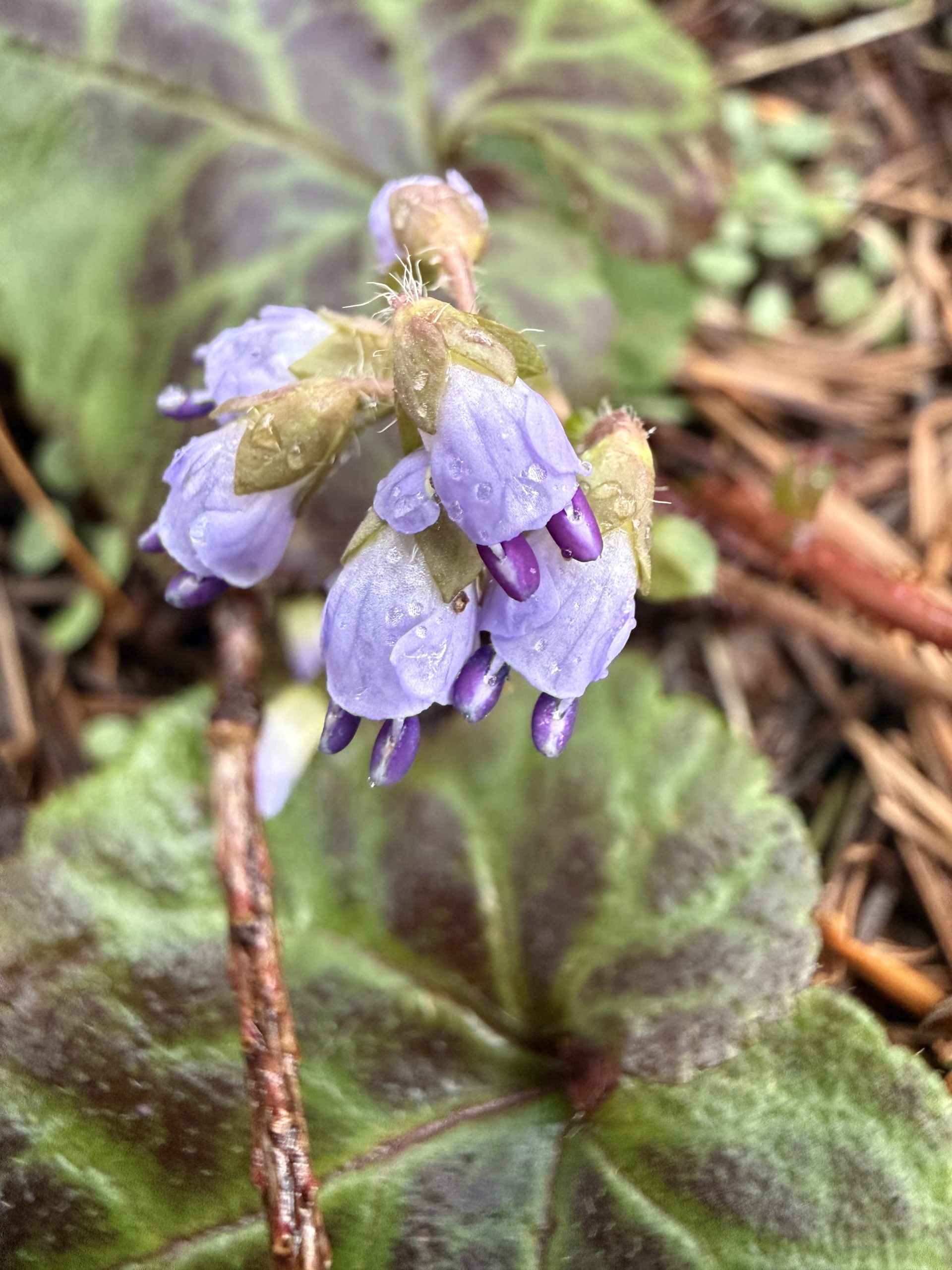
The plant that symbolizes this season most to me is Veronica regina-nivalis (formerly Synthyris reniformis), the Snow Queen.

Veronica is a pretty large genus (to some botanists, including the commonly known genus Hebe) in the family Plantaginaceae, which includes Plantain, Snapdragons, Penstemon, and Digitalis. The leaves remind me a lot of Asian Saxifrage species, though they are not related. It has a relatively narrow native range, with a few scattered populations on the east side of the Olympic Peninsula, through the S Puget Sound, west of the Cascade crest in Oregon and southward to Mendocino County, CA. Western Oregon is its homeland for sure. You’ll find this diminutive plant growing almost exclusively in coniferous forests. Here at Edgelands, the minute you get into mature Doug Fir woodland, it is everywhere. Leave the needled canopy, and it disappears, though there is one spot here where the seed has seemingly washed downhill and several colonies are growing under the canopy of Oregon Ash, Serviceberry, Oak and Beaked Hazelnut. These outliers seem to be thriving despite the mat of decomposing leaves that cover them each winter. I’ve seen nice swathes growing under Doug Fir at the initial south trail switchbacks at Mt. Talbert Nature Park, if you have an inclination to go see some right now.

Snow Queen seeds readily where it’s happy – you can find dense clusters of small seedlings grouped around the mama plant in the 1-2″ layer of forest duff. When I’ve moved some plants from the pathways, I found this fluffy layer is rather shallow – the roots of the plants are all down in the relatively compact gravelly loam. The roots are pretty deep and sturdy too – why you’ll see these plants go limp in the dryness of early September and fully rehydrate with the fall rains. Common associates in the understory are Corylus cornuta var. californica, Oemleria cerasiformis, Mahonia aquifolium and nervosa, Polystichum munitum, Symphoricarpos albus and mollis, Gaultheria shallon and Rubus ursinus. Mixing in at the ground layer we find Cardamine nuttallii, Lysimachia latifolia, Vicia americana, Bromus vulgaris, Lathyrus polyphyllus, Vancouveria hexandra and a few Trillium ovatum.

Snow queen is a reeeallly “quiet” plant. When you walk into the woods where it lives and look around you won’t notice it at first. The soft periwinkle flowers really blend in with the forest floor, and they are quite tiny. But slow down a minute, crouch maybe, and you’ll start to notice them if you’re in the right environment. I love this kind of plant – overlooked, but obviously important in its abundance. So February.
A couple other subdued plants to take note of this week include Cardamine nuttallii, Oaks Toothwort, and Oemleria cerasiformis, Oso Berry. The Toothwort appears out of nowhere in January, growing from small tubers underground – very difficult to dig and transplant! While doing so (out of pathways in the woods) I noted that the leaf emerging from the ground really is no indication of where the tuber is – the leaf stalk wiggles its way through the hard soil and emerges in somewhat random fashion, sometimes several inches from the tuber. Interestingly, just below the soil surface, they form a small “bulbil” on the leaf stem, ensuring that they can propagate themselves vegetatively as well as by their popping seed (they are in the same genus as the gardener’s bane, Shotweed!). We’ll take a look at Toothwort again when it blooms in March, for sure. Another species you gotta squat and squint to really notice in bloom!

The Oso Berry is a much more straightforward plant, all activity visible above ground. Here at Edgelands we have mostly male plants, the species being dioecious. Like the Veronica, you know it attracts native insects for pollination but for the life of me, I never see any winged or crawling visitors. But just because we don’t see the plant sex happening doesn’t mean it isn’t, as female Oso Berry are typically laden in orange tiny-egg-like fruit in the summer. In the woods here they are a gentle haze, interesting up close, disappearing into the network of other deciduous plants from a distance. There are a few on my drive to work that are out in full sun and they will really make you do a double-take…..so many flowers when they’re out of the woods.

If you are a fan of BBC Gardener’s World, you know Monty finishes each episode with a “jobs for the weekend” segment. With 5 acres and one set of hands there are always a lot of “jobs”, so I consider them “jobs for the season”. Blackberry, Ivy, and Holly digging has finished. I like to do that work in winter so I don’t crush emerging perennials and shred the foliage of shrubs and trees when trampling around the woods and fields. We’ll get into exotic plant removal in upcoming posts about restoration practices, but a few other tasks that are lower impact were quick and easy to accomplish in February. Leaving the woods, we go out to the fields, where voles have created a vast trail system beneath the matted pasture grasses (more on mowing cessation in the next post!). Where you have lots of voles, you’ll have lots of coyotes and owls.

Fawns are not safe either. I did some seeding of Epilobium densiflorum, Dense Spike Primrose, in open patches in the pasture grass. It’s a reliable and heavy re-seeder that doesn’t get eaten by exotic slugs and snails or native deer, voles or rabbits. Looking forward to seeing their diminutive but cheery spikes of pink flowers this coming summer!

Recently, I was thrilled to find a colony of Plagiobothrys figuratus, Fragrant Popcorn Flower, that perpetuated itself near where I had scattered seeds two years ago. You gotta admire a plant that can germinate and grow while submerged in several inches of water (the bottom 3rd of the Edgelands site is very wet in winter, with vernal pools from December through May or June).

Another easy task for February was girdling several Prunus avium, Sweet Cherry, that are growing in dense deciduous woodland. I’m no logger, and have only recently learned to use a chainsaw, but I feel that even for an experienced tree remover, felling these trees these would damage some mature white oak. Plus more dead snags will keep the birds and insects happy!

Despite the invasive nature of this exotic tree, I still felt bad determining its fate in this way. One practice I’ve come to value is balancing creation with destruction. If I spend a day digging Armenian blackberry, pulling weeds, or girdling cherries, I’ll try to spend as much time creating life – potting up plants in the nursery, sowing seeds, or planting out some new species. Pretty woo-woo, but to me it just feels right. If we spend all of our time outside cutting, trimming, pulling (destroying, basically) it can change our perspective enough that we come to see gardening or land care as just a chore (a “job for the weekend”). We are so burdened with responsibility and tasks in the parameters of our current system, that I feel it’s important to step aside from these control and management efforts (consciously, say it out loud if you need to) to perform some life affirming tasks centered on creation. Pull ten weeds, plant ten plants. We can likely agree that more life is better than less, and balancing our desire to “remove” or “edit” with the practice of “adding” or “enhancing” is surely one small way to feel more connected to the natural processes that surround us. As mentioned above, a part of “becoming indigenous to place”.

Who is that looking back at you? Why that is our friend the Red-Breasted Sapsucker, common here at Edgelands especially in the winter. They have chosen several stressed Bigleaf Maple for their feasting, with dozens of concentric rows of holes tap-tapped into the bark of these trees. The oozing sap stains the trunks black, likely from either fungi or bacteria feeding on the sugars in the seeping sap.
Here at the end of the month, the Robins are back big time, chittering and chirping in cacophonous fashion especially in the morning and at dusk. Common winter birds like White Breasted Nuthatch, Brown Creeper and Bewick’s Wren have been relatively quiet for the last few weeks. Year-round constants like European Starling, Ravens, Stellar’s Jay, and Black Capped Chickadees are familiarly present and active. Haven’t seen a deer in at least 4 months since I spotted a buck in the neighbor’s field to the south. Last year, almost every day featured a doe and one or two fawns making their circuit. Ground fruiting fungi are at a relative minimum, but the decomposers on wood are hard at work. I’ll leave you with this image of a fungus (as yet unidentified) that likes decomposing Hazelnut trunks. A large branch had fallen out of a Beaked Hazelnut (the last remaining European Hazelnut on the property was recently cut down) and I went to move it out of the pathway. Nope. Fused solid to a neighboring branch. I imagine a future where fungi are used to bind materials together – this bond was pretty impressive! May the bonds that connect us to the place we call home be as strong, and may they allow us all to appreciate the wonders of (even) February!

Leave a Reply