Hello! Welcome to the Edgelands blog! I’m Greg. If you find yourself here for this first post you likely know me, or at least know the work I’ve done over the years with plants here in the Pacific Northwest. This will be a non-corporate platform for open discussion of the ideas and practices (and the plants!) that can hopefully help us proceed forward from an environment and culture of dismissal, destruction, greed and extraction towards one of mutual care, cultivation, and celebration of the bonds that hold all living things together. (No offense to non-living things – rocks are cool too!)
What you read here is the first blog post I’ve ever written. Behind the times I suppose, but in character for a luddite. Since this is the first post on the website for an enterprise that is new to y’all, I suppose one might consider this writing/reading a “beginning”. I’ve been contemplating the concept of “starting” something and what that means for a while…….when launching a new project, it makes sense to consider it having “begun” on this date or that. But is it really a beginning, or a point on a variance in a continuous, if wavering, line?

Some of you may be familiar with the works of Robert Jordan, who began most of the 500 (lol) novels in WOT with an embellished description of a certain wind, that was never “the beginning”, but “a beginning”. I could consider launching this blog and small enterprise “a beginning” but viewed in the context of the work I’ve devoted the majority of my adult life to, it’s a natural progression that draws upon all of my past experiences, and represents the direction my intellectual and economic pursuits have led me.

I think about 35 or so years of intense interest in all things plants – how do we “get that bug?” – and how I still appreciate the ones that used to be my favorites (Melianthus! I will always love you!). Starting grapefruit and kiwi seeds plucked from the kitchen fruit bowl was how it all “began”. I think of a moment driving up the Willamette Valley after picking up an order of plastic pots at a nursery supply company, counting the native species I saw along the way. I think of the miles and miles that passed without seeing any. It’s somewhat mournful, feeling the loss of an ecosystem all at once, but I felt it that day. Instead of pushing me into grief it fueled a keen interest in learning all the overlooked species that once inhabited the lands we now whizz past in our cars. It wasn’t a break from my previous interests and pursuits in horticulture, just an abrupt extension.
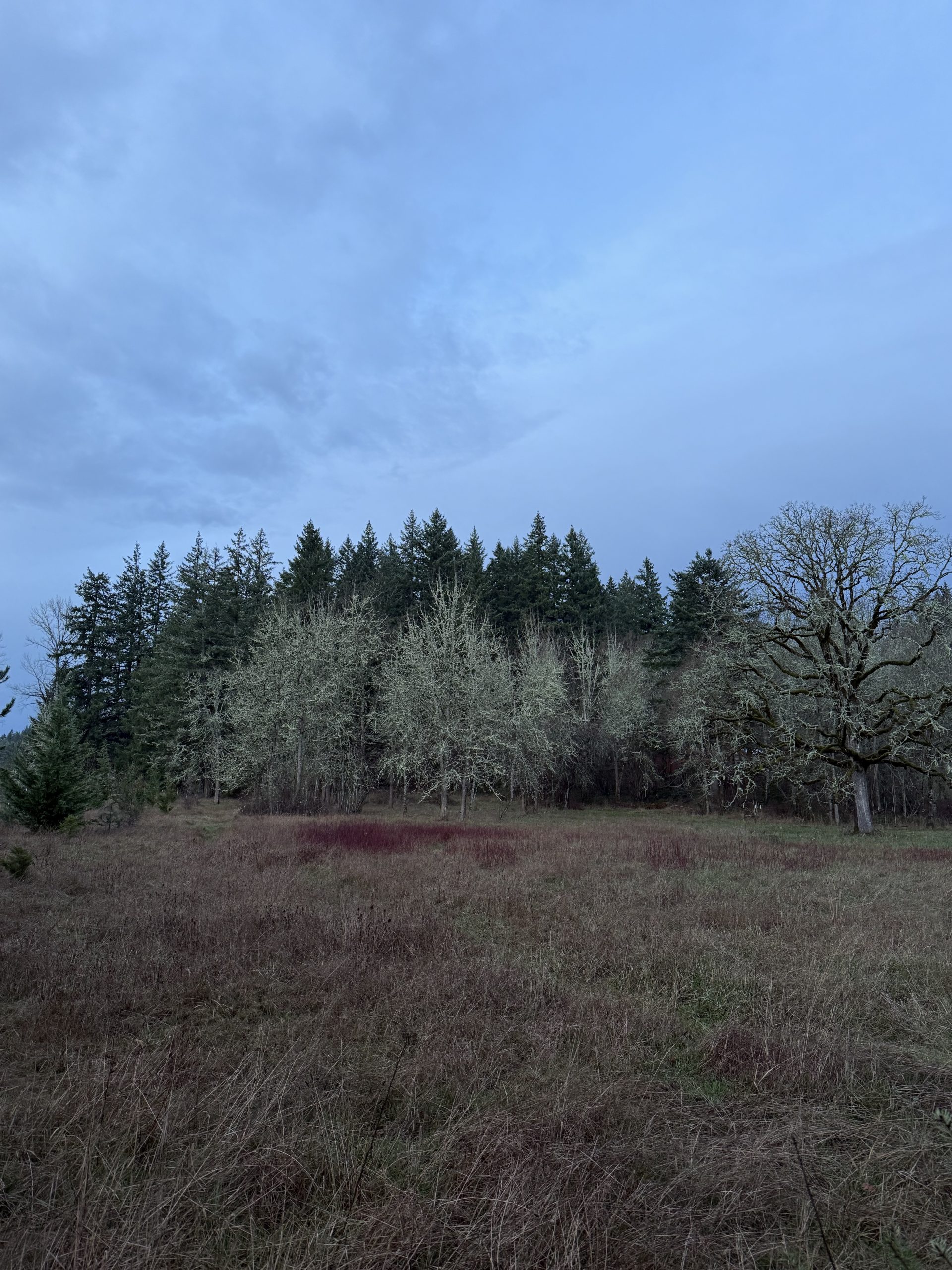
I think about the 5 acres of woodland and fields that is now the Edgelands site. A lot of hard work and good luck allowed my husband and me to land here, and in the last two years I’ve spent many hours out there, feeling every square foot of the land, learning its seasonal character, which species pop up unexpectedly, and which areas are prone to flooding in the winter, where the Brown Creepers like to feed, where the blackberry canes arch from across the fence line. I think about the underlying geology, the Troutdale Formation, a reddish loam laden with river rock, deposited by the outflow from an ancient Columbia River that ran before the Cascades were formed. I think of indigenous people who would have traversed or harvested from this small patch. Was this specific spot special to them? How much time did they spend managing these oak stands, looking out for deer, harvesting camas? I think of the settlers who moved here and fenced things off, logged the woods. They must have cared too? Same land, different outlook? I think of the previous owners – I can tell they cared. I see where they cut ivy from the trees, kept blackberry trimmed back, planted some Incense Cedar. And we’re here now, “owners” because that’s what you have to be in our current system in order to feel and experience “independence” on a patch of land. Are we beginning to restore the native habitat here, or just carrying the torch forward in a different way?

I think about the time of year as I’m writing. It’s early February now – the beginning of something for sure: the endless “sprinter” we have here in NW Oregon. From this point forward, each week brings something new – the first Snow Queen flowers in the woods (noted on 1/25/26 this year), the swelling Oso Berry flower buds. Before you know it the leaves will be back, and each moment must be savored. Or is Winter Solstice the beginning of the year? The return of light is fitting for the start of something too.
I have a fondness for the start of the rainy season – about the time I started thinking about this essay – which usually happens sometime in early October. It’s an overlooked “beginning” to a circularly-defined calendar year, but to me the quiet subtle changes that start right then are special. Over the last decade, our dry seasons have become more pronounced, with up to 6 months of hard soils and desiccation in a climate that’s perceived as ultra-rainy. As leaves senesce, if you stand outside and stay quiet for a while, you can feel the rain soak into the soil, reactivating the soil microbes. You can feel the mosses and lichens rehydrate, animating the thousands of small life forms that inhabit them. Within a week or two you’ll see the seed of native species germinate (the weeds will too – many of them are supremely climate adapted!). Truly a beginning.
But should we view time as circular? It’s comforting but simultaneously disconcerting to think of everything coming back on itself to repeat the same act over and over. You know that movie. The seasons do happen on schedule and the same processes repeat themselves – yet, differently. Familiar, yet completely unique. So I like to think of time and existence as a long continuous line with lots of waves, wobbles and loops. Some guidelines, but no hard and fast rules. So has something truly “begun” or just “evolved”?

I often think of the phrase “perception is reality”. When I internet-searched this phrase, I found it is associated with authoritarian political figures, which is horrifying. I’ve always considered it a (somewhat cynical?) truth. What each of us can sense becomes “real” – imperceptible ideas and objects and processes surely can’t be strong elements of “reality”, can they?
I often think about toilet paper rolls – not in a literal sense, as that would just be weird – but in the sense that we’re always looking out at the world through one. Occasionally we can drop that cardboard tube from our eye to catch an overwhelming glimpse of the vast “reality” we just can’t focus on throughout the day. But for most of us, the ways and degrees to which we can perceive something do determine what we consider to be “real”.
I’m currently (re) listening to a book on animal perception (An Immense World by Ed Yong – highly recommended!) which is another source of input that has helped me look out at that world through a wider “tube”. Understanding that the various animals we see every day sense the world in a completely different fashion than we do is fascinating, and liberating. For most of our days – work, obligation, relationships, errands, etc – we have to maintain that tight focus. One thing at a time. But the more we can find time to expand our perception, the more of the world we can introduce into our reality.

And with that we “circle” back to the purpose of this blog (or, we follow a line with “lots of waves, wobbles, and loops”!), which is to change perception with the purpose of inspiring a change in practice. Specifically, I hope to address our role as humans in the broader ecosystem, where our actions as a species have undue influence. Can we discard (or at least expand?) that toilet paper roll and view how we live and work in the context of the vast connections that exist between ourselves and other living creatures? Once we see them, they do become real. Using our energy to promote and encourage life would be the continuation of a long undulating wave that has surged and ebbed since we started to evolve as a species.
Shall we begin?
Leave a Reply